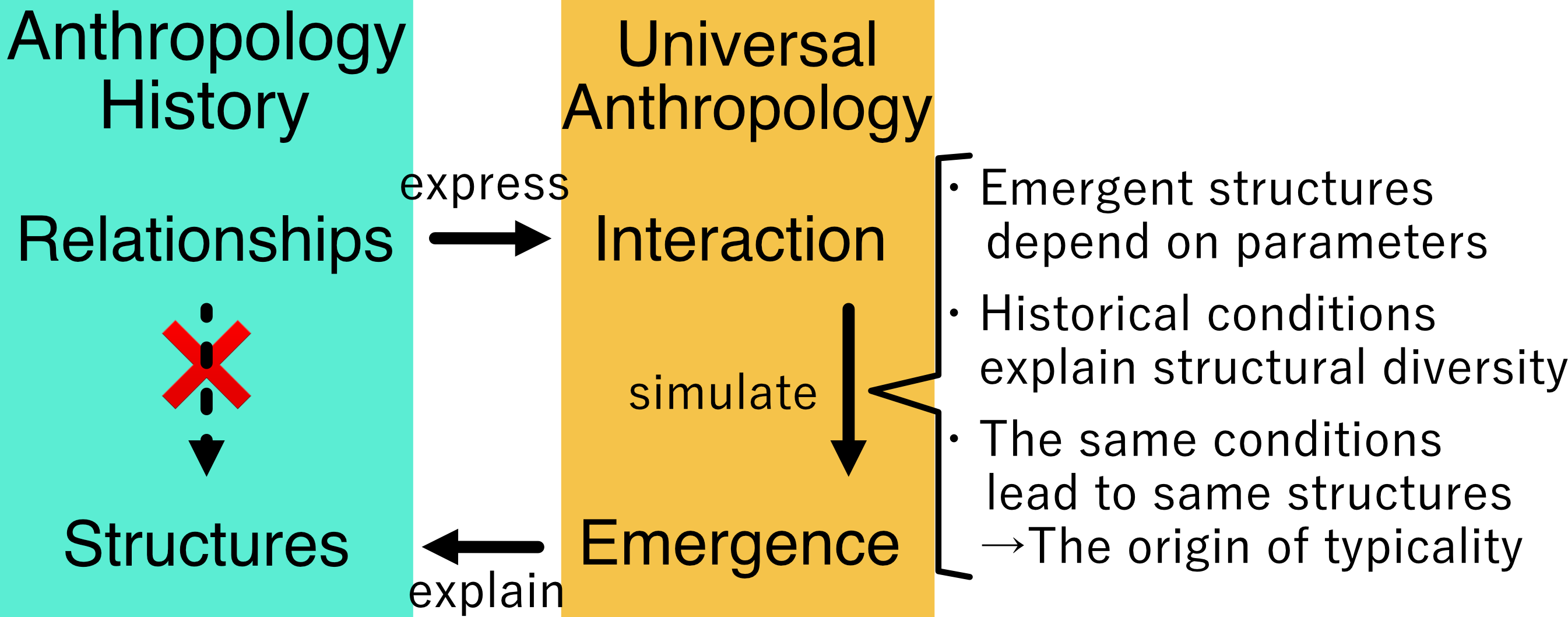
Research
Why do geographically distant societies often develop similar cultural forms? This is one of the central questions in human history. Anthropologists and historians have long identified recurring structural patterns across cultures from different times and regions. I argue that such similarities emerge because there are underlying mechanisms that generate culture wherever humans form societies. Drawing on ideas from statistical physics and evolutionary theory, I study how micro-level interactions among individuals give rise to macro-level social structures, and pursue a theoretical framework for universal anthropology.
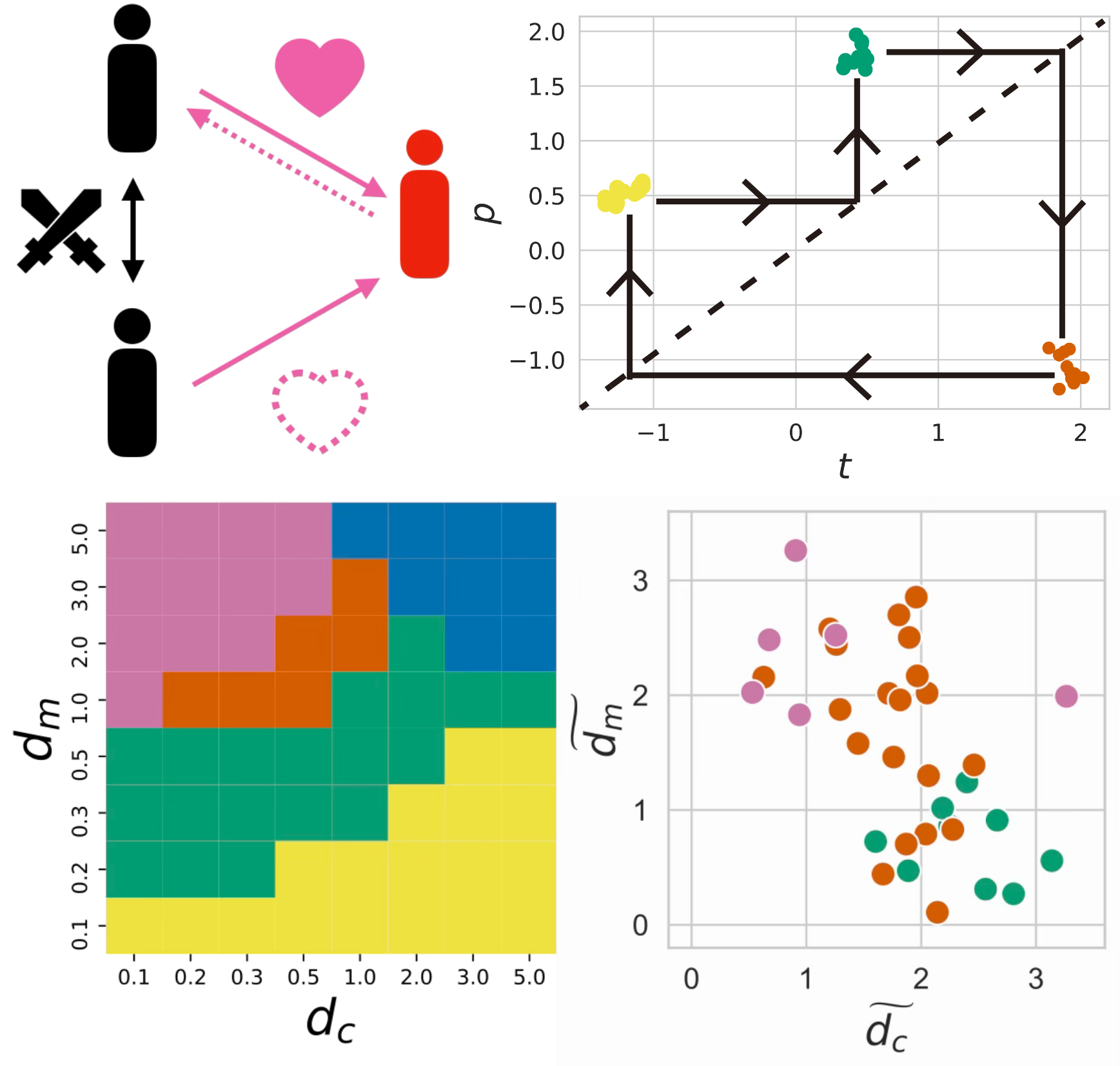
The Evolution of Kinship Structures
Rules such as “children of the sun should marry children of the moon,” in which people are classified into cultural groups (clans) and marriage is permitted only between particular clans, are fairly common in traditional small-scale societies. In cultural anthropology, the structure formed by the relations that determine marriageability between clans is called a kinship structure. Although several typical patterns have long been known, it remained unclear how such structures emerge and how regional differences among them can be explained. We therefore focused on a general feature of human societies: marriage creates solidarity among affines while also generating rivalry over mates. By expressing these interactions in a mathematical model, we showed through evolutionary simulations that macro-level kinship structures can emerge spontaneously.
Related readings: Claude Lévi-Strauss, The Elementary Structures of Kinship; Itao & Kaneko, PNAS 2020; Itao & Kaneko, Proceedings of the Royal Society B 2022; Itao & Kaneko, PNAS 2024
Related press coverage: RIKEN (2024)
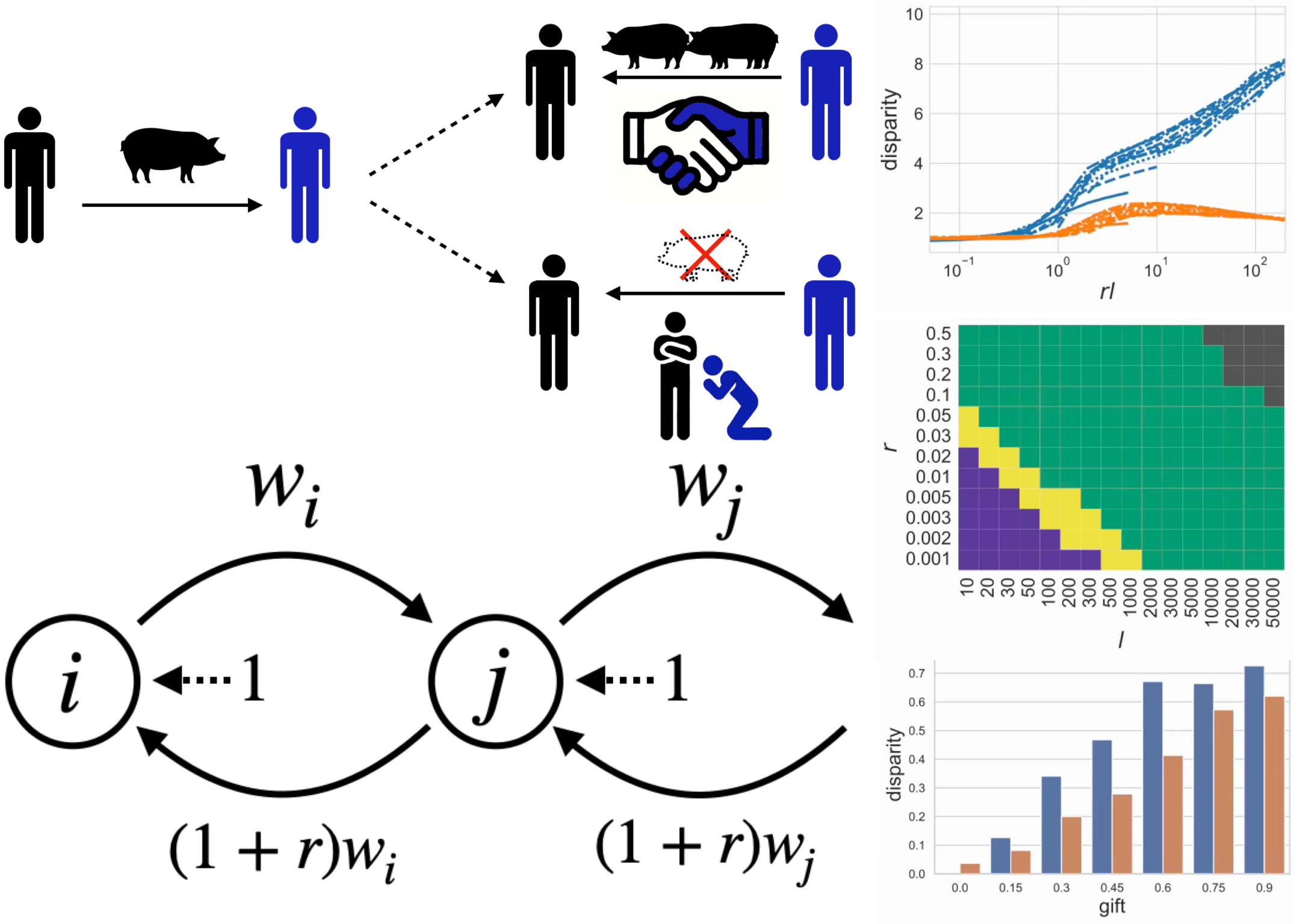
Transitions of Social Organization through Competitive Gift-Giving
In many traditional societies, receiving a public gift entails an obligation to return something even greater, and failure to do so may result in a loss of prestige. Such customs are widely found in ethnographic records, with the potlatch of Indigenous peoples of the Northwest Coast being one of the best-known examples. We call this competitive gift-giving. We developed a model of competitive gift exchange and showed that it can generate both wealth inequality and status inequality within society. As the frequency of gift-giving and the required rate of reciprocation increase, social structure shifts across a sequence of forms: kin-based bands, tribes integrated by solidarity, stratified chiefdoms, and kingdoms with stable royal authority.
Related readings: Marcel Mauss, The Gift; Elman Service, Primitive Social Organization; Itao & Kaneko, Humanities and Social Sciences Communications 2023; Itao & Kaneko, PLOS Complex Systems 2024
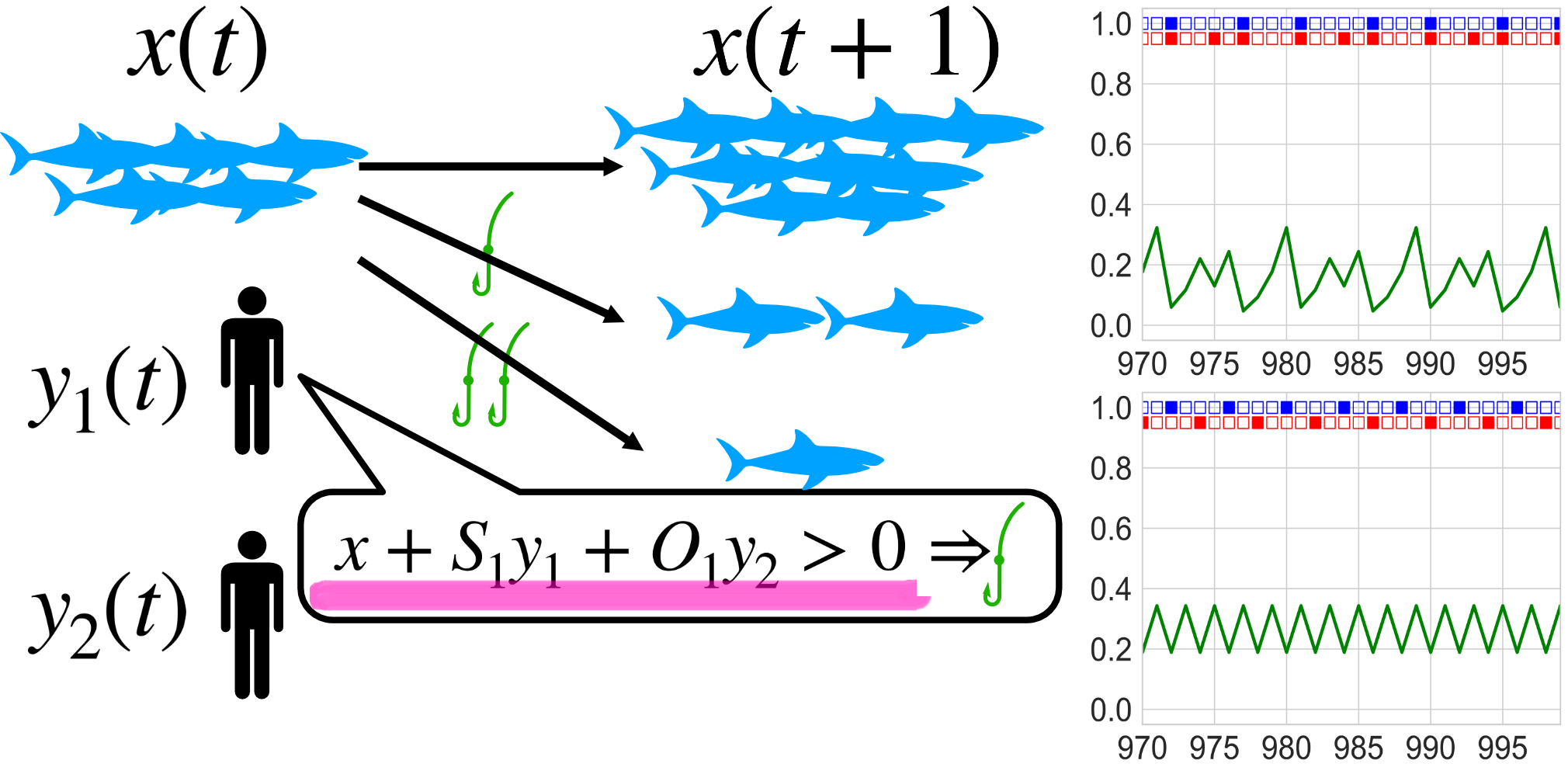
Self-Organization of Institutions through Evolutionary Dynamical-Systems Game Theory
Natural resources such as groundwater, forests, and fisheries are often difficult to divide and are therefore jointly managed. If everyone rushes to use them before others do, the resources are quickly depleted and a tragedy of the commons occurs. Historically, however, people have created various institutions—such as rotational access systems and closed fishing seasons—to avoid such outcomes. While it has become clear what kinds of institutions can sustain resource use, it has remained unclear how such institutions emerge in the first place. By combining dynamical systems theory with evolutionary game theory into what we call evolutionary dynamical-systems game theory, we study how decision-making evolves in dynamic resource-management games and reveal how institutions can self-organize.
Related readings: Elinor Ostrom, Governing the Commons; Itao & Kaneko, PNAS 2025
Related press coverage: RIKEN (2025)